
Solar Energy
Every day, the Earth receives an extraordinary flow of energy from the Sun. It happens continuously, silently, and on a scale that is almost impossible to imagine. We experience it as sunlight, warmth, changing seasons, and the cycle of day and night. Yet behind these familiar effects lies the primary energy source that makes life on Earth possible.
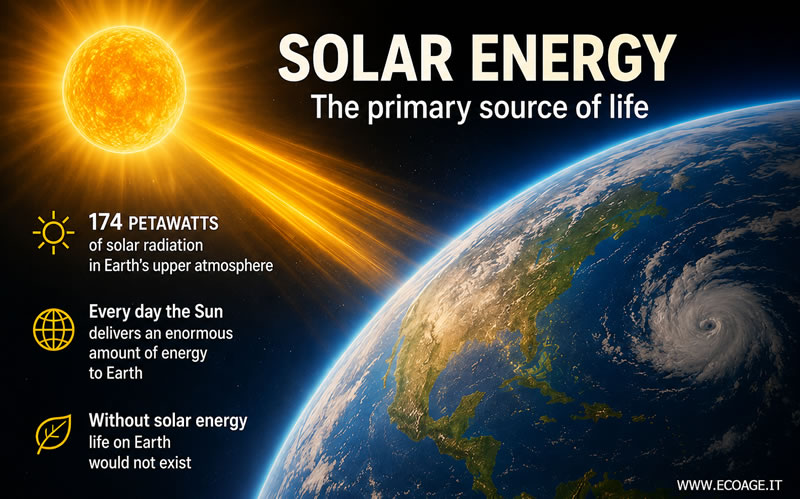
Solar energy is the radiant energy emitted by the Sun and received by our planet. About 174 petawatts of solar radiation reach the Earth's upper atmosphere. To put that into perspective, the amount of solar energy arriving every day is vastly greater than the total energy consumed by human civilization.
Fortunately, not all of this radiation reaches the Earth's surface directly.
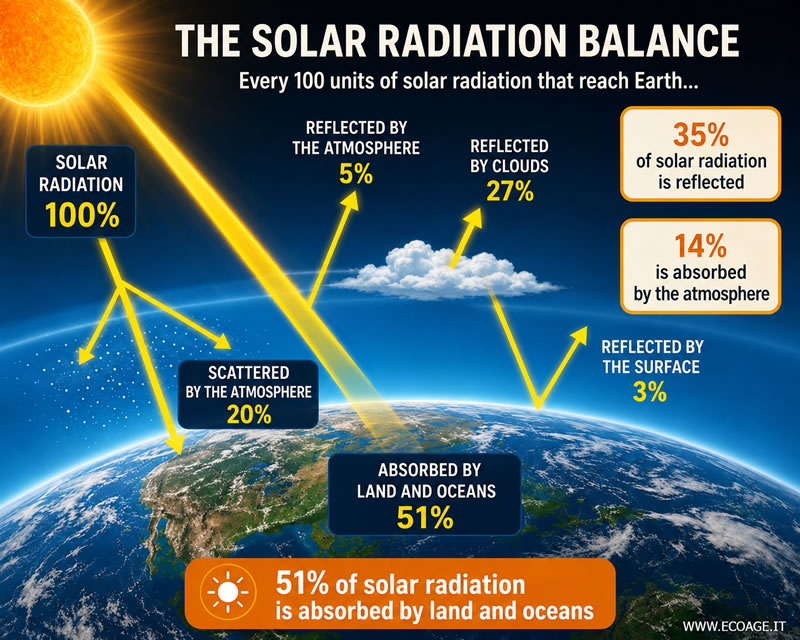
The atmosphere acts as a natural protective shield. Part of the incoming radiation is reflected back into space, part is absorbed by atmospheric gases, and part is scattered in different directions. Without this filtering effect, the Earth's surface would receive far more harmful radiation, making life as we know it impossible.
Approximately 35% of incoming solar radiation is reflected by clouds, the atmosphere, and the Earth's surface. Another 14% is absorbed by atmospheric gases.
One gas is especially important: ozone. The ozone layer absorbs much of the Sun's most dangerous ultraviolet radiation, protecting living organisms from severe biological damage. In many ways, it acts like a giant natural filter surrounding the planet.
The Earth's Energy Balance
The atmosphere does more than simply block radiation. It also redistributes sunlight through a process known as scattering. Around 20% of incoming solar radiation is scattered in different directions. This phenomenon of light scattering explains why the sky appears bright even when we are not looking directly at the Sun.
As sunlight passes through the atmosphere, both the quantity and the characteristics of the radiation change. The atmosphere modifies the intensity of solar energy and alters its electromagnetic spectrum before it reaches the Earth's surface.
The Earth does not permanently store all the energy it absorbs. Our planet constantly releases energy back into space, mainly in the form of infrared radiation, often referred to as thermal radiation.
This continuous exchange creates the Earth's energy balance. Incoming solar radiation and outgoing thermal radiation must remain relatively balanced over time. Even small variations in this equilibrium can influence the planet's climate and average temperature.
The Energy Behind Life on Earth
Solar energy is not only responsible for light and heat. It is also the foundation of life itself.
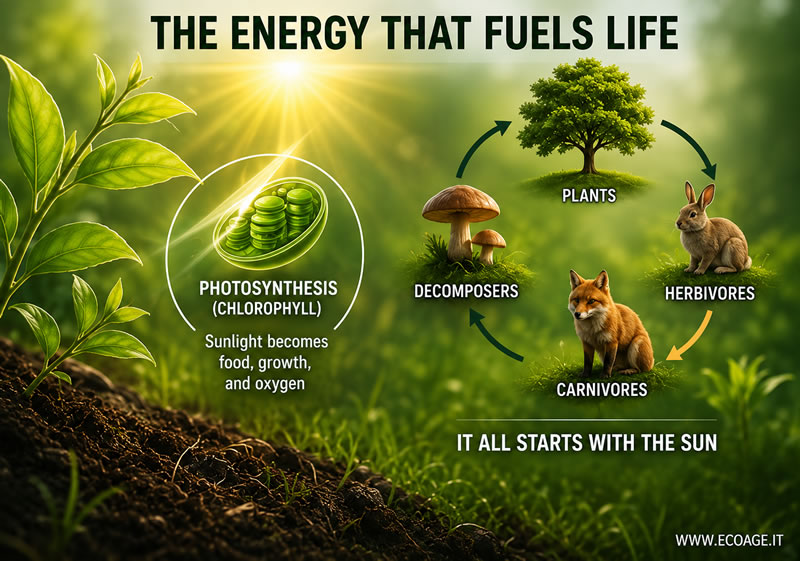
Plants use photosynthesis to convert sunlight into chemical energy. Using solar radiation, water, and carbon dioxide, plants produce organic matter and release oxygen into the atmosphere.
This process supports the entire food chain. Herbivores depend on plants, predators depend on other animals, and decomposition recycles nutrients back into the soil. At the base of nearly every ecosystem on Earth lies solar energy transformed by photosynthesis.
How Humans Use Solar Energy
Modern technologies increasingly attempt to do what nature has done for billions of years: capture sunlight and convert it into usable energy.
Each square meter of the Earth's upper atmosphere receives approximately 1367 watts of solar power. Although the amount reaching the ground is lower, especially at higher latitudes, the total available energy remains enormous.
One of the most common applications is the use of solar thermal panels. These systems absorb solar heat and transfer it to a fluid, typically water or an antifreeze solution. The heat can then be used to produce hot water, warm buildings, or support industrial heating systems.
These solar collectors are commonly installed on rooftops. Their dark surfaces maximize the absorption of solar radiation, allowing the internal fluid to heat efficiently under sunlight.
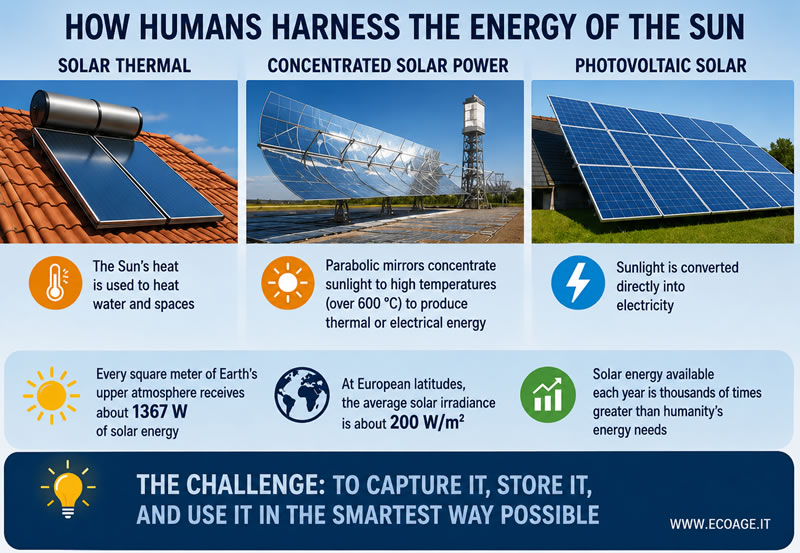
Another important technology is represented by concentrated solar power systems. Instead of simply absorbing sunlight, these systems use parabolic mirrors or reflective surfaces to focus solar radiation into a single point.
At the focal point, temperatures can exceed 600 °C. This intense heat is used to generate high-pressure steam, which drives turbines connected to electrical generators. The principle is similar to that of conventional thermoelectric power plants, except that the energy source is sunlight rather than fossil fuels.
Large concentrated solar power plants are often built in desert regions, where solar irradiance is particularly strong and consistent throughout the year.
The most widespread solar technology today, however, is the photovoltaic panel.
Unlike thermal systems, photovoltaic panels convert sunlight directly into electricity through the photovoltaic effect. Semiconductor materials such as silicon release electrons when exposed to light, generating an electric current.
Each photovoltaic panel contains multiple interconnected cells. When sunlight strikes these cells, photons transfer energy to electrons inside the semiconductor material, causing them to move and produce direct current electricity.
This electricity can be used immediately, stored in batteries, or supplied to the electrical grid. Thanks to this flexibility, photovoltaic technology has become one of the fastest-growing energy solutions in the world.
The Growth of Solar Technologies
In recent decades, solar technologies have improved dramatically. Modern panels are more efficient, more affordable, and more widely accessible than ever before.
Today, photovoltaic systems can be found on homes, industrial buildings, farms, parking structures, highways, and even spacecraft and satellites.
What makes solar energy especially remarkable is its simplicity. Human civilization is increasingly learning to harness the same source of energy that has illuminated and warmed the Earth for billions of years.
At the same time, solar energy still presents important technical challenges. Solar radiation is diffuse and intermittent. Energy production varies with weather conditions, seasonal changes, and the natural cycle of day and night.
For this reason, one of the major technological challenges of the future will be improving energy storage systems and making solar power generation more stable and efficient.
Still, one fact remains extraordinary: every day, the Sun provides Earth with far more energy than humanity currently consumes. The real challenge is not producing energy, but learning how to capture, store, and use it intelligently.


