
SUSTAINABLE DEVELOPMENT
The term "sustainable development" is often used to describe a path of economic and social growth that respects social equity, environmental protection, and the rights of future generations. The concept was first defined in 1987 in the famous report *Our Common Future*, also known as the Brundtland Report, named after its chair. It aims to balance the needs of the present with those of the future, ensuring a sustainable future for everyone.
The difference between traditional and sustainable development
In economics, there are various models of development—there isn’t a single approach. Traditional and sustainable development represent two different perspectives within this broader spectrum.
- Traditional development. This has been the dominant model from the earliest civilizations to the present day. Nature is viewed as a resource to be transformed or exploited to improve human quality of life.
- Sustainable development (Sustainable Development). In the 20th century, a new development paradigm emerged, focusing on addressing major environmental challenges and the increasing scarcity of natural resources. Though still largely an academic concept, the international community has shown clear intent to make meaningful progress towards its realization.
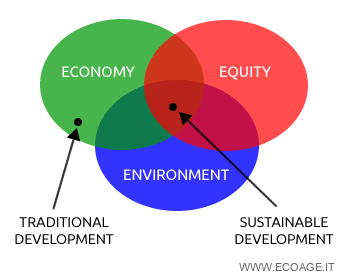
The rule of the three Es. Sustainable development has taken on a broader meaning compared to traditional development, which focuses solely on economics (Economics). Climate change (Environment) and social equity (Equity) have brought to light the fact that development cannot be limited to economic growth alone—it must also take into account environmental impact and social justice. For this reason, sustainable development is built on three key pillars: economy, environment, and social equity (Economics, Environment, Equity). These are known as the "three Es" and represent an integrated approach to economic growth, environmental protection, and social justice.
From infinite growth to limits of development
In the second half of the 20th century, the conventional model of development faced a critical turning point. The overuse of natural resources led to their rapid depletion. Early signs of resource scarcity appeared, such as the oil crisis of the 1970s, alongside the first global environmental issues like the greenhouse effect, ozone depletion, and widespread smog.
The classical development model inevitably leads to ecological and economic crises.
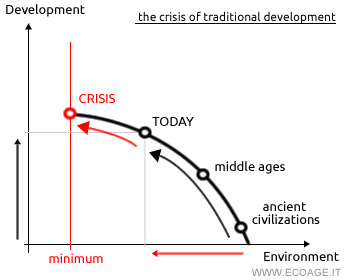
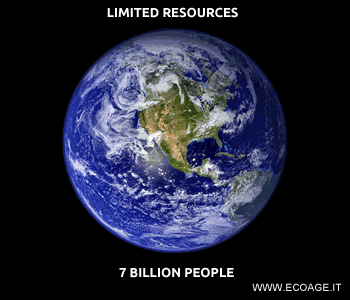
Rapid population growth, increasing industrialization, and globalization have dramatically changed how humans view the planet. We no longer see it as an endless frontier to conquer but as a closed system with finite resources that require careful and responsible management. It's like we’re all aboard a spaceship or living in a global village with eight billion people.
In the 1970s and 1980s, various academic studies introduced the concept of limits to economic growth. This idea was quickly embraced by much of the scientific community, especially with the spread of the theory of entropy. This theory argues that in a closed system like Earth, it's impossible to fully recover all energy, applying the first two laws of thermodynamics to economic systems.
These studies reinforced the idea of a global limit to progress and growth, proving that economic development cannot be infinite. This undermined confidence in technology alone as a solution and highlighted the need for a new development paradigm: sustainability.
Sustainable development
The concept of sustainable development is closely linked to conserving natural resources and protecting the environment. In this model, the economy and environmental protection are interconnected rather than in conflict, allowing for a more effective response to resource scarcity and pollution. Sustainable development respects environmental limits without depleting natural resources.
So why is it called "sustainable"? The answer is simple: an economic system cannot be based on unchecked resource consumption that leads to future crises. In other words, the system must be able to sustain itself over time.
The chart below shows three examples of sustainable development (A, B, C).
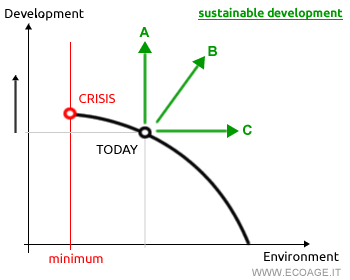
At the starting point (today), humanity has the opportunity to achieve more advanced development without depleting natural resources (A). We can also choose to restore natural resources (for example, through reforestation) without hindering economic development (C), or adopt a mixed approach (B).
A practical example of sustainable development. One concrete example of sustainable development is the use of renewable energy sources, such as solar, wind, geothermal, and hydropower. These allow for energy production without depleting non-renewable energy resources (like oil, coal, and gas) and with minimal environmental impact in terms of pollution. Another sustainable practice is recycling, which reuses raw materials in new production cycles.

In conclusion, sustainable development is based on economic growth that respects environmental limits and avoids leading to crises. Therefore, it is more enduring over time.
The difference between sustainable development and degrowth
It's important to clarify that sustainable development and degrowth are two distinct concepts that are often confused. Sustainable development does not oppose economic growth, nor does it advocate for degrowth. Instead, it aims to reconcile economic growth with social goals, equity, and environmental preservation.


