
Galactic Coordinate System
The galactic coordinate system is a celestial coordinate system used to describe the positions of astronomical objects within the Milky Way. Unlike the equatorial coordinate system, which is based on Earth's rotation axis, the galactic system is aligned with the structure of our galaxy itself. It is defined using the galactic plane and the Milky Way's axis of rotation.
The system is centered on the Sun because the Solar System lies very close to the galactic plane. This makes galactic coordinates especially useful for mapping stars, nebulae, star clusters, and other objects distributed throughout the Milky Way.
The galactic plane defines the galactic equator, the broad region containing most of the stars, interstellar gas, and dust in the galaxy. When we observe the night sky from the Solar System, the center of the Milky Way appears along this plane in the direction of the constellation Sagittarius. The galactic equator is inclined by about 62° relative to Earth's celestial equator.
The galactic rotation axis corresponds to the Z-axis of the coordinate system. This axis is perpendicular to the galactic plane. The north galactic pole is located above the galactic disk, while the south galactic pole lies below it.
The position of a celestial object in the galactic coordinate system is described using the following coordinates
- Galactic latitude (b)
Galactic latitude measures the angular distance of a celestial object from the galactic equator, as observed from Earth. Like geographic latitude on Earth, it is usually measured in degrees (°) from -90° at the south galactic pole to +90° at the north galactic pole. A latitude of 0° corresponds exactly to the galactic plane.
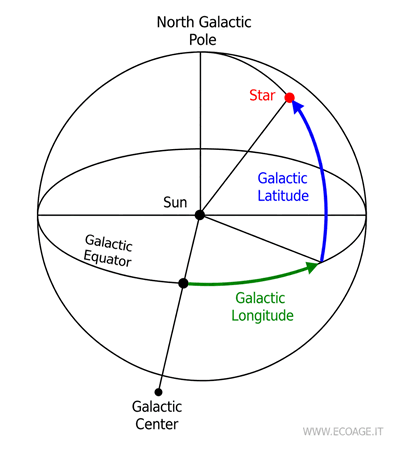
- Galactic longitude (l)
Galactic longitude measures the angle, taken counterclockwise, from the direction connecting the Sun to the center of the Milky Way. This reference direction points toward Sagittarius. Like terrestrial longitude, galactic longitude is generally expressed in degrees (°).
The galactic coordinate system was formally established by the International Astronomical Union (IAU) in 1958. Because the Sun slowly changes position as it moves through the galaxy, the coordinate framework also changes gradually over time. In particular, galactic longitude slowly decreases because the coordinate system itself does not rotate with the galaxy. Later, the J2000 reference system was adopted, with coordinates referred to January 1, 2000.
In some cases, astronomers also specify the galactic distance of a celestial object, meaning its distance within the galactic coordinate framework. On galactic scales, distances are typically expressed in parsecs or light-years. Galactic coordinates are therefore written as (l, b, d), where l represents galactic longitude, b represents galactic latitude, and d represents galactic distance.
Using these three coordinates, astronomers can accurately identify and map celestial objects throughout the Milky Way, including stars, nebulae, star clusters, and other galactic structures.


