What Is the Sun?
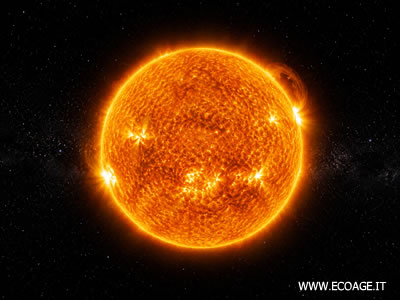
Every day we see it crossing the sky above us. It feels familiar, constant, almost ordinary. Yet the Sun is one of the most extraordinary objects in the known universe: a gigantic cosmic engine that has powered life on Earth for billions of years.
Without the Sun, there would be no oceans, no forests, no weather, and no changing seasons. Even the food we eat depends on solar energy. In fact, fossil fuels such as oil and coal are essentially ancient sunlight stored in Earth’s geological past.
And despite its importance to us, the Sun is only one of roughly two hundred billion stars in the Milky Way Galaxy.
A Giant Sphere of Plasma
The Sun is not a “ball of fire,” as it is often described. Scientifically speaking, it is a massive sphere of plasma, a state of matter made of ionized gas heated to extremely high temperatures.
Gravity continuously pulls this enormous mass inward toward the center of the star. As the pressure increases, temperatures rise to extraordinary levels. Deep inside the Sun, these conditions become extreme enough to trigger nuclear fusion, the process that powers the star.
The Sun is divided into several regions. Astronomers distinguish an invisible central core, internal layers, and an outer solar atmosphere. The visible surface we observe from Earth is part of this outer atmosphere.
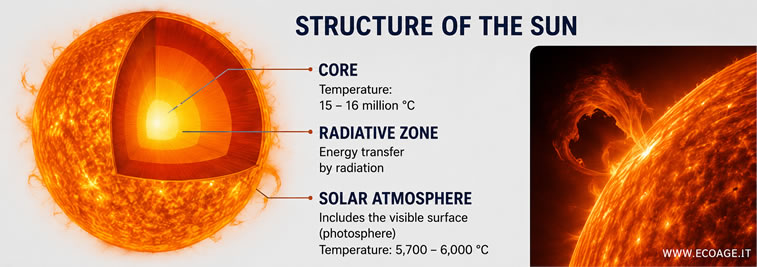
At the visible surface, called the photosphere, temperatures average around 5700-6000 °C. But conditions inside the core are far more extreme. Although the core cannot be observed directly, scientists estimate that temperatures there reach approximately 15-16 million degrees Celsius.
This is where nearly all the Sun’s energy is produced.
An “Average” Star That Is Still Enormous
Compared with many other stars in the universe, the Sun is considered relatively ordinary. Astronomers classify it as a main-sequence star belonging to the G2 spectral class, characterized by its yellow-white appearance.
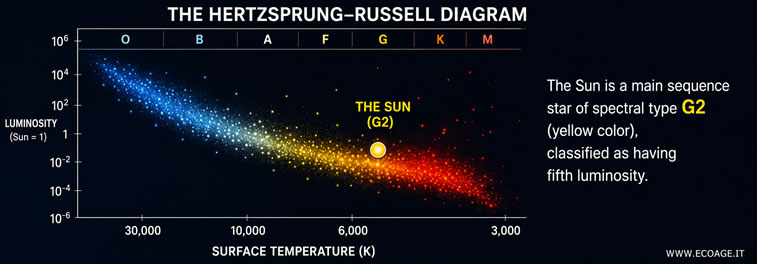
This classification appears in the famous Hertzsprung-Russell diagram, one of the most important tools in modern astrophysics. The diagram compares stars according to their luminosity, temperature, and stage of evolution.
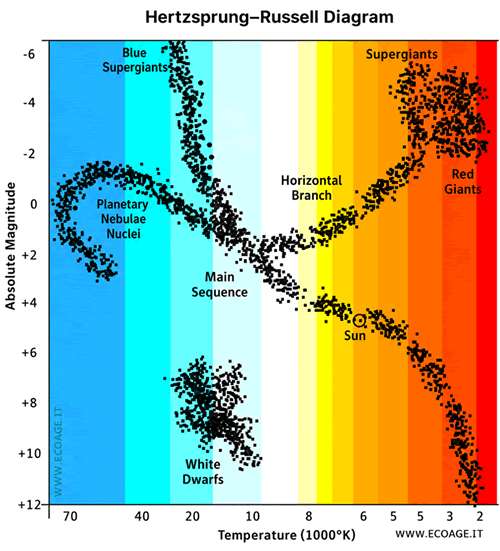
Even though the Sun is considered an average star, its size is difficult to imagine on a human scale.
The Sun’s radius is approximately 696,500 kilometers, more than 109 times the radius of Earth. If the Sun were hollow, it could contain more than one million planets the size of Earth.
It looks huge in our sky mainly because it is relatively close to us. In reality, many stars in the universe are much larger.
The Sun’s mass is estimated at about 2 × 1030 kilograms, approximately 330,000 times the mass of Earth. Its gravitational field is so powerful that it keeps planets, comets, asteroids, and all the other bodies in the solar system in orbit around it.
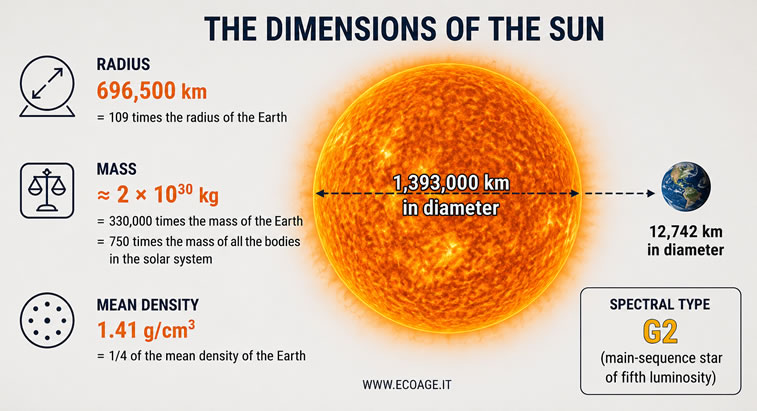
Despite its enormous size, the Sun is composed mainly of light elements such as hydrogen and helium. Because of this composition, its average density is relatively low: approximately 1.41 g/cm³, about one quarter of Earth’s average density.
The Right Distance for Life
Earth orbits at an average distance of 149.6 million kilometers from the Sun. This distance is enormous, yet incredibly well balanced.
Over the course of the year, Earth’s orbit changes slightly, causing the distance from the Sun to vary between approximately 147.1 and 152.1 million kilometers.
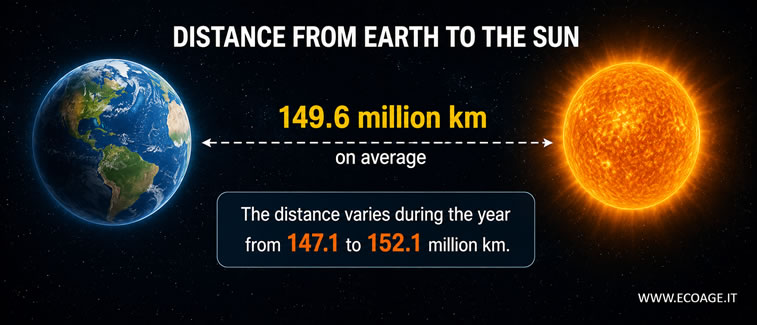
On an astronomical scale, this variation is relatively small. And this balance is essential for life.
If Earth were significantly closer to the Sun, the oceans would eventually evaporate. If it were much farther away, the planet would become frozen.
How the Sun Produces Energy
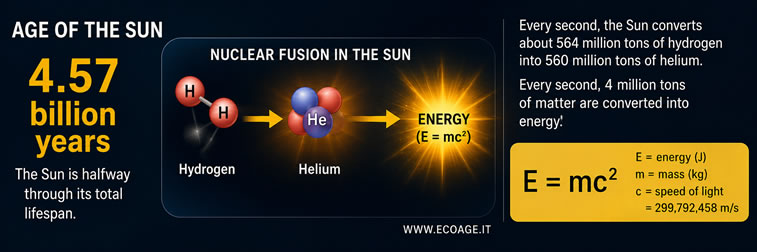
The Sun is estimated to be approximately 4.57 billion years old. Based on the typical lifespan of stars similar to it, the Sun is currently about halfway through its life cycle.
For billions of years, the Sun has generated energy through nuclear fusion. Deep inside the core, hydrogen nuclei fuse together to form helium nuclei.
During this process, something remarkable happens: the resulting helium nucleus has slightly less mass than the original hydrogen nuclei.
That “missing” mass is converted into energy.
Albert Einstein described this relationship with one of the most famous equations in physics:
$$ E = mc^2 $$
In this equation, $ E $ represents energy, $ m $ represents mass, and $ c $ represents the speed of light in a vacuum.
The equation reveals a revolutionary idea: even a tiny amount of matter can release an enormous quantity of energy.
This process takes place continuously inside the Sun.
Every second, the Sun converts approximately 564 million tons of hydrogen into 560 million tons of helium. The remaining 4 million tons are transformed directly into energy and radiated into space.
The Energy That Sustains Earth
The Sun constantly emits electromagnetic radiation and charged particles, including neutrinos. This immense flow of energy powers the entire solar system.
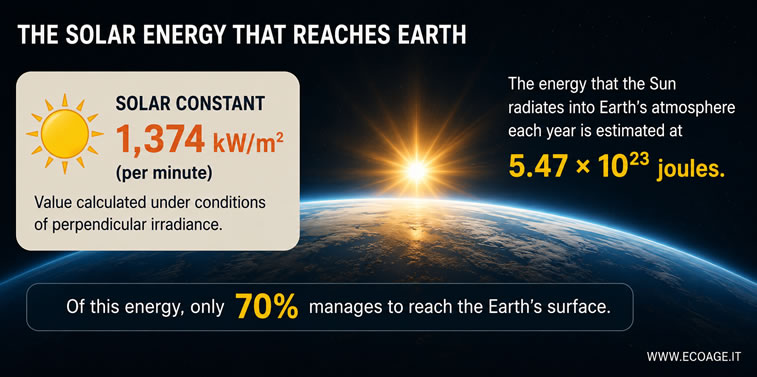
The amount of solar energy reaching Earth is described by the solar constant, equal to approximately 1.374 kW/m² under direct solar illumination.
Overall, the Sun delivers approximately 5.47 × 10²³ joules of energy to Earth’s atmosphere every year.
However, not all of this energy reaches the ground.
The Long Journey of Sunlight
Earth’s atmosphere acts as a natural filter. Roughly half of incoming solar radiation is scattered, reflected, or absorbed before it reaches the surface.
Some sunlight is scattered back into space by atmospheric gases. Another portion is reflected by clouds, oceans, and land surfaces through the albedo effect. The rest is absorbed by the atmosphere and by Earth’s surface itself.
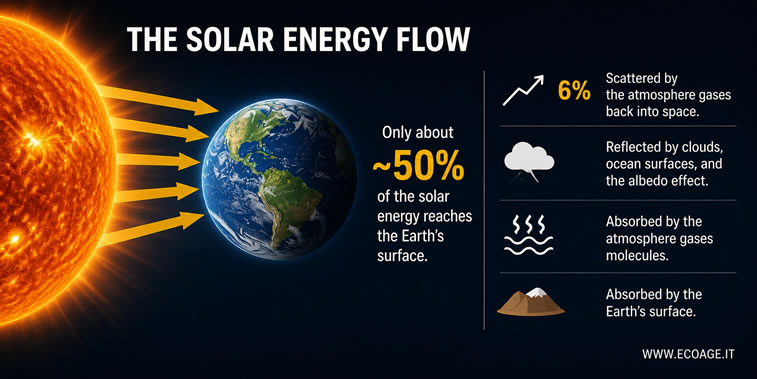
In the end, only about 50% of solar energy actually reaches Earth’s surface. Yet this is enough to drive Earth’s climate, power the water cycle, sustain photosynthesis, and support every known form of life.
Every forest, every ecosystem, and every breath we take ultimately depend on a yellow star that formed nearly five billion years ago in one region of the Milky Way Galaxy.
And while life continues on Earth beneath its light, the Sun silently carries on its cosmic process: transforming matter into energy, second after second, for billions of years.