
Hour Angle Coordinate System
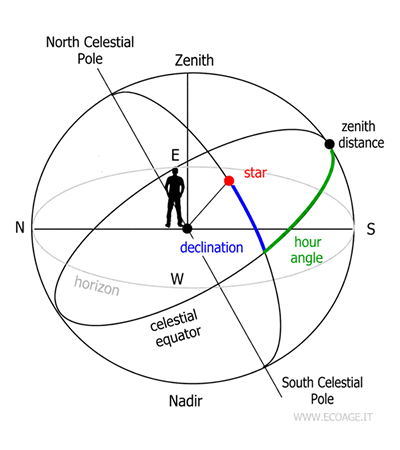
The hour angle coordinate system is an astronomical coordinate system used to describe the position of celestial objects on the celestial sphere. Unlike fixed coordinate systems, it depends on the observer's location and the time of observation. The system is based on two coordinates: declination and hour angle.
- Declination
Declination indicates how far a celestial object lies north or south of the celestial equator, which is the projection of Earth's equator onto the celestial sphere. It is measured along the hour circle passing through the object and the celestial poles.
Declination is expressed in degrees. A value of 0° corresponds to the celestial equator, while +90° and -90° correspond to the north and south celestial poles respectively.
- Hour Angle
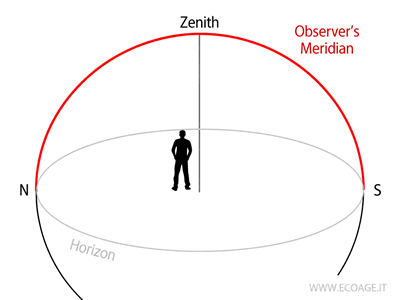
The hour angle measures the angular distance between the observer's local meridian and the hour circle passing through the celestial object.What is the local meridian? The local meridian is the great circle on the celestial sphere that passes through the zenith and the north and south points of the observer's horizon. The point where it intersects the celestial equator serves as the reference point for measuring the hour angle.
The hour angle is measured westward from the local meridian in hours, minutes, and seconds. Because of Earth's apparent rotation, the hour angle changes continuously throughout the day, ranging from 0 to 24 hours.
This coordinate is particularly useful in observational astronomy because it directly indicates how much time has passed since a celestial object crossed the observer's meridian. For this reason, the hour angle coordinate system is widely used for telescope alignment and sky tracking.


