
Ecliptic Coordinate System
The ecliptic coordinate system is one of the main coordinate systems used in astronomy to describe the positions of celestial objects and track their motion across the sky. It is especially important in the study of the Solar System because it uses the ecliptic, namely the plane of the Earth's orbit around the Sun, as its reference plane.
This choice of reference is particularly convenient because most planets, aside from Mercury, and many smaller bodies in the Solar System move along orbits that are only slightly tilted relative to the ecliptic. Depending on the chosen frame of reference, the center of the celestial sphere may be placed either at the center of the Earth or at the center of the Sun.
In the ecliptic coordinate system, the position of a celestial object is defined by two coordinates:
- Ecliptic Latitude (β)
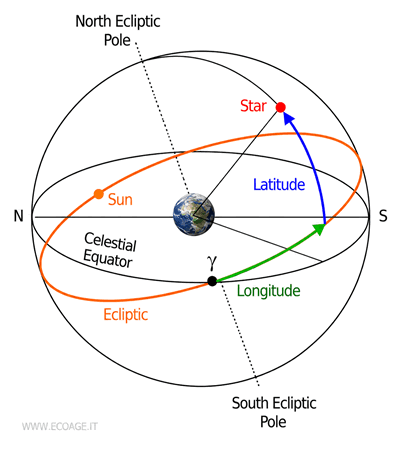
Ecliptic latitude, also called celestial latitude, measures how far a celestial object lies north or south of the ecliptic plane. The measurement is taken along the great circle passing through the object and the ecliptic poles, and it is expressed in degrees.This coordinate works in a way similar to geographic latitude on Earth. Values range from 0° to +90° in the northern celestial hemisphere and from 0° to -90° in the southern celestial hemisphere. An object located directly on the ecliptic has a latitude of 0°, while the north and south ecliptic poles correspond respectively to +90° and -90°.
- Ecliptic Longitude (λ)
Ecliptic longitude, also called celestial longitude, measures the angular position of an object along the ecliptic. The measurement starts from the gamma point (γ), also known as the vernal equinox, and increases eastward from 0° to 360°.More precisely, it is the angular distance measured along the ecliptic between the vernal equinox and the point where the circle of ecliptic longitude passing through the celestial object intersects the ecliptic. This coordinate plays a role similar to right ascension in the equatorial coordinate system.
In ancient astronomy, the twelve zodiac signs were traditionally used to indicate ecliptic longitude and describe the apparent position of celestial bodies along the ecliptic.
What is the gamma point? The gamma point, also known as the vernal equinox, is the point where the Sun crosses the celestial equator during the March equinox. The term "vernal" refers to spring in the northern hemisphere, since this event marks the beginning of the spring season. It usually occurs around March 20 or 21, when day and night are approximately equal in length.
The ecliptic coordinate system does not depend on the Earth's daily rotation, which makes it relatively stable over short periods of time. However, over very long timescales, the system slowly changes because both the celestial equator and the ecliptic gradually shift their orientation in space under the influence of gravitational forces.
One of the most important effects responsible for these changes is precession. This is a slow conical motion of the Earth's rotational axis, similar to the wobbling motion of a spinning top. Because of precession, the coordinate system itself slowly changes over time. One complete precessional cycle takes about 26,000 years.
The Earth's axis is also affected by a smaller oscillatory motion known as nutation. Nutation is caused mainly by the gravitational pull of the Moon and produces small periodic variations in the orientation of the Earth's rotational axis.
For this reason, astronomers must always specify the reference date associated with a set of celestial coordinates. This reference instant is called the epoch. An epoch defines the exact moment in time to which the coordinates refer.
The standard epoch currently used in astronomy is J2000.0, corresponding to the configuration of the celestial coordinate system on January 1, 2000. To calculate the position of a celestial object at another date, astronomers apply corrections for effects such as precession, nutation, proper motion, and other known motions.


