Sun’s Internal Structure and Atmosphere
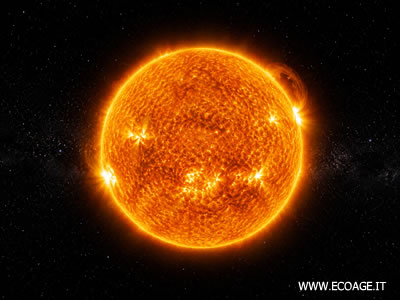
When we look at the Sun in the sky, it seems simple and familiar: a bright sphere shining above Earth every day. But beneath that intense light lies one of the most extreme and powerful environments in the universe. Inside the Sun, matter is compressed under enormous pressure, temperatures rise to millions of degrees, and vast amounts of energy are produced every second.
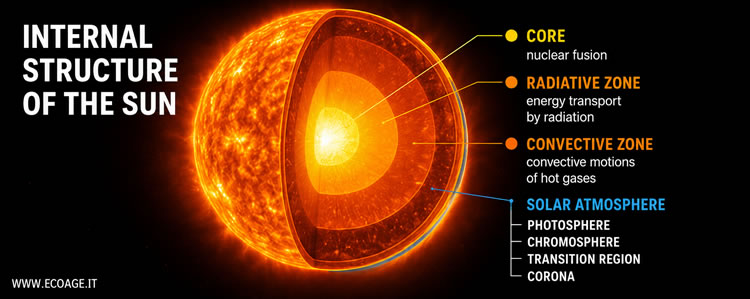
The visible surface is only a small part of the story. Beneath it lies a complex internal structure made up of different layers, each with its own physical properties and role in transporting energy from the center of the star out into space.
By studying sunlight and the particles emitted by the Sun, astronomers have gradually reconstructed its internal organization. Today, the Sun is generally divided into two major regions: the solar interior and the solar atmosphere.
Solar Interior
The deepest regions of the Sun form its interior, where energy is generated and slowly transported outward through different physical mechanisms.
Solar Core
At the very center of the Sun lies the core, the hottest and densest region of the star. Here temperatures reach millions of degrees, and the pressure is so immense that hydrogen nuclei collide and fuse together.
This process is called thermonuclear fusion. During fusion, hydrogen is transformed into helium, releasing enormous amounts of energy in the form of radiation and heat. Every ray of sunlight that reaches Earth ultimately originates in this hidden region deep inside the Sun.
The core is therefore the true engine of the star. Without it, the Sun would simply be a cold and dark sphere drifting through space.
Radiative Zone
Surrounding the core is the radiative zone, where energy moves outward mainly through electromagnetic radiation, especially gamma rays.
In this region, photons are continuously absorbed and re-emitted by the surrounding plasma. Because of these countless interactions, their journey becomes incredibly slow. A single photon may take thousands or even millions of years to travel across the radiative zone.
Convective Zone
Farther from the center lies the convective zone, where the transport of energy changes completely.
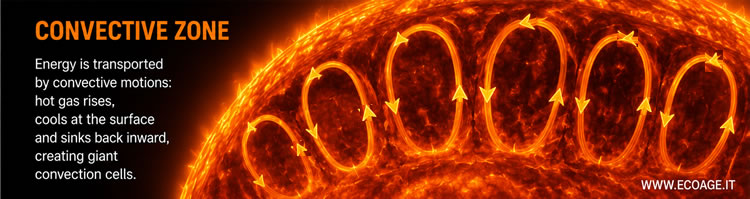
Here energy is no longer transferred mainly by radiation. Instead, it is carried by convection, the large-scale motion of hot plasma. Hot material rises toward the surface, cools down, and then sinks back inward, creating enormous convection currents.
This process is similar to the circulation of boiling water inside a pot and constantly stirs the outer layers of the Sun.
Solar Atmosphere
After traveling outward from the interior, energy finally reaches the visible layers of the Sun, collectively known as the solar atmosphere.
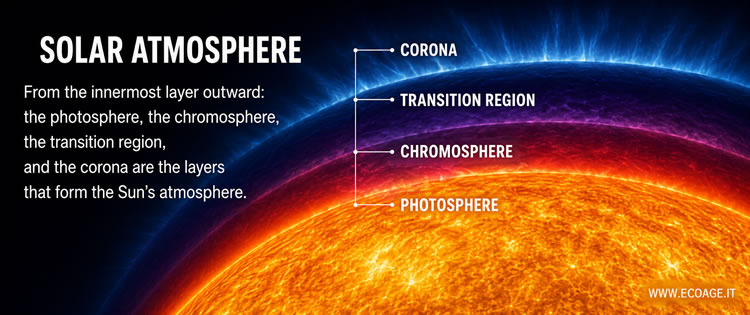
The solar atmosphere is divided into several layers: the photosphere, the chromosphere, the transition region, and the corona. Each one is characterized by unique physical conditions and spectacular phenomena.
Photosphere
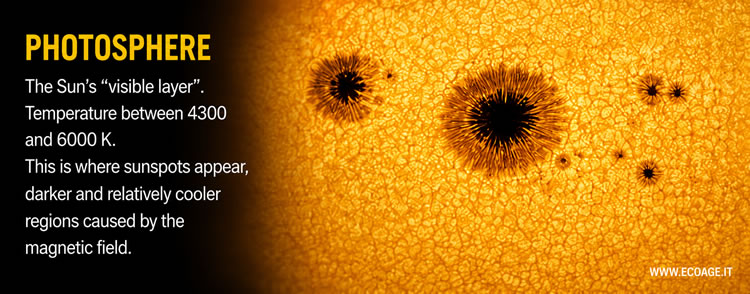
The photosphere is the lowest layer of the solar atmosphere and represents the visible "surface" of the Sun.
Although it is only a few hundred kilometers thick, its temperature ranges from approximately 4300 K to 6000 K. This is the layer that emits most of the visible light we observe from Earth.
The photosphere is also where sunspots appear. These darker and cooler regions are associated with intense magnetic activity. Their number changes over time according to the approximately eleven-year solar cycle, showing that the Sun is an active and dynamic star.
Chromosphere
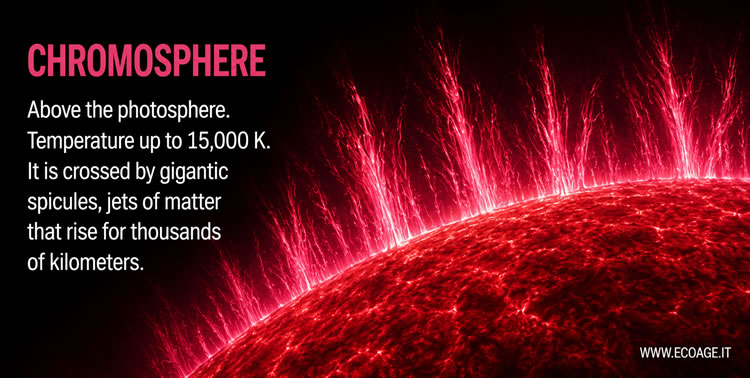
Above the photosphere lies the chromosphere, a layer of rarefied gas approximately 2000 kilometers thick.
Here the temperature begins to rise again, reaching about 15,000 K. The chromosphere is crossed by enormous jets of plasma known as spicules, which can extend thousands of kilometers into space.
This creates a highly dynamic environment that is constantly changing.
Transition Region
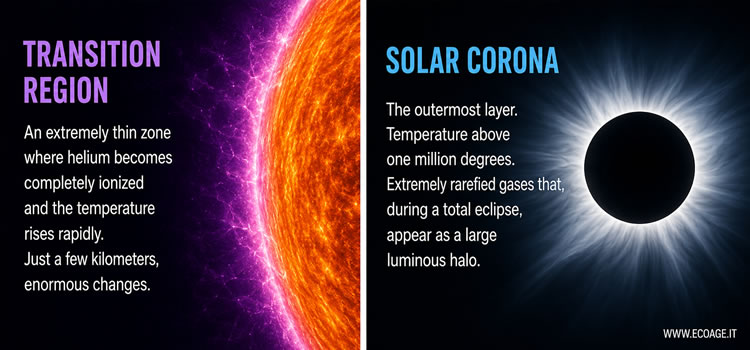
Between the chromosphere and the corona lies a thin transition region where physical conditions change extremely rapidly.
In this narrow layer, helium becomes fully ionized, the properties of the radiation change significantly, and the temperature rises abruptly over a relatively short distance.
For this reason, astronomers consider the transition region one of the most complex areas of the solar atmosphere.
Solar Corona
The corona is the outermost layer of the Sun and also one of its greatest mysteries.
Despite being much farther from the core, it reaches temperatures exceeding one million kelvin. Scientists are still investigating the physical mechanisms responsible for heating the corona to such extreme temperatures.
The coronal gases are extremely rarefied and usually invisible. However, during a total solar eclipse, the corona becomes visible as a vast luminous halo surrounding the darkened Sun.
For centuries, this spectacular phenomenon has fascinated astronomers and observers around the world.
Studying the structure of the Sun means understanding the immense stellar engine that powers our solar system and makes life on Earth possible. From the nuclear reactions inside the core to the outer corona extending into interplanetary space, every layer reveals a different aspect of how stars function.
And perhaps that is the most remarkable part of all: all this complexity and all these extraordinary physical processes remain hidden behind the seemingly simple sunlight that illuminates our sky every day.