How the Sun Was Born
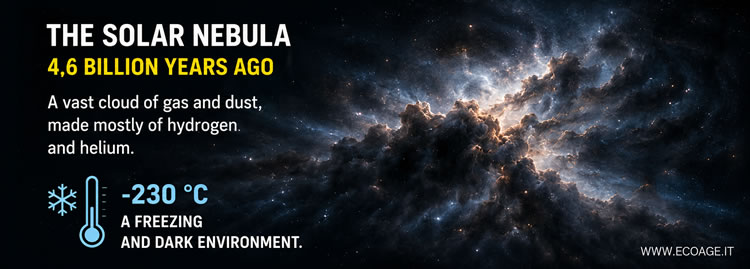
About 4.6 billion years ago, the Solar System did not yet exist. There were no planets, no oceans, and no familiar sky illuminated by the Sun. In its place, there was only an immense cloud of gas and dust drifting through space: the solar nebula.
This gigantic nebula was far larger than the modern Solar System and consisted mainly of hydrogen and helium, the most abundant elements in the universe. Tiny particles of cosmic dust floated within the gas. Temperatures were extremely low, around -230 °C, making the region cold, dark, and apparently motionless.
At some point, the nebula began to collapse under its own gravity. Scientists are still not entirely certain what triggered this process, but one possible explanation is the shock wave produced by a nearby supernova explosion. That disturbance may have destabilized the cloud, causing gas and dust to slowly move inward toward the center.
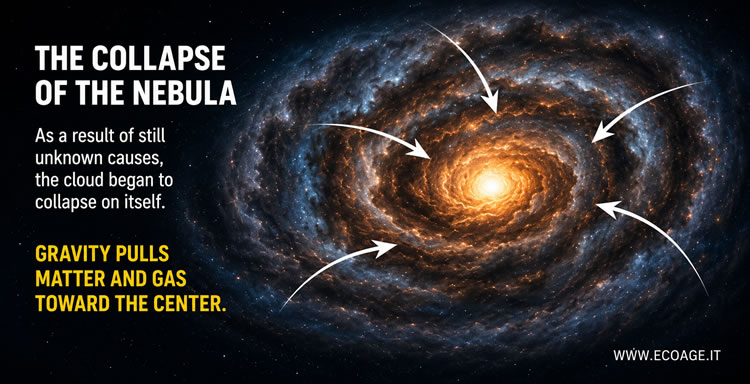
As material accumulated in the central region, pressure and temperature increased dramatically. This growing concentration of matter became the protosun, the early stage in the formation of the Sun.
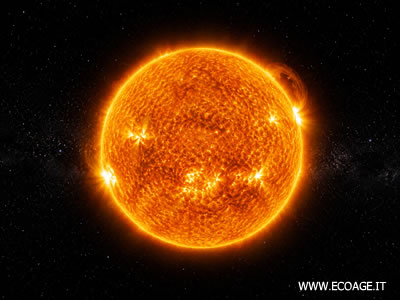
Over time, conditions inside the protosun became extreme. Temperatures rose high enough for nuclear fusion to begin. Hydrogen nuclei started fusing into helium, releasing enormous amounts of energy. With the onset of nuclear fusion, the Sun was born.
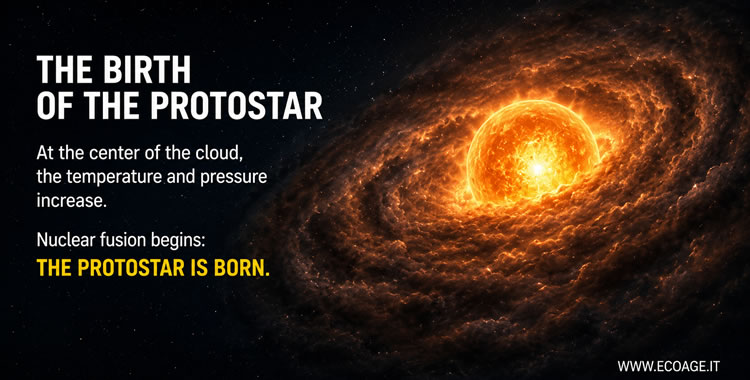
While the protosun was forming, the remaining gas and dust flattened into a rotating structure surrounding it: the protoplanetary disk. This disk became the environment in which the future planets of the Solar System would take shape.
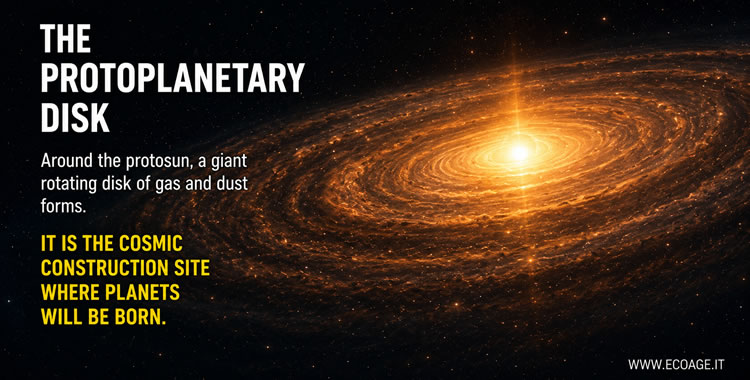
Inside the protoplanetary disk, microscopic particles of dust and ice constantly collided. Some of these particles stuck together, gradually forming larger and larger bodies known as planetesimals.
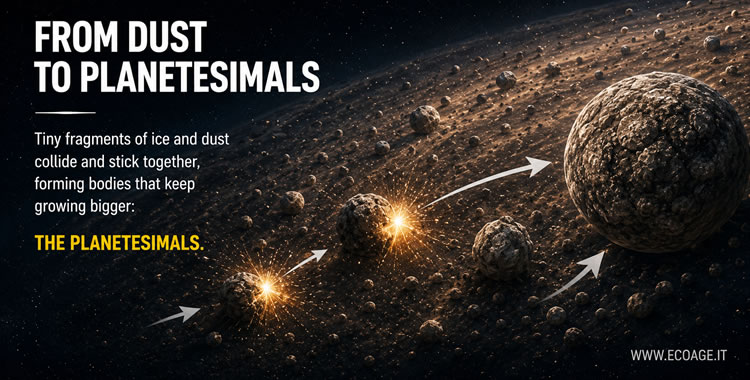
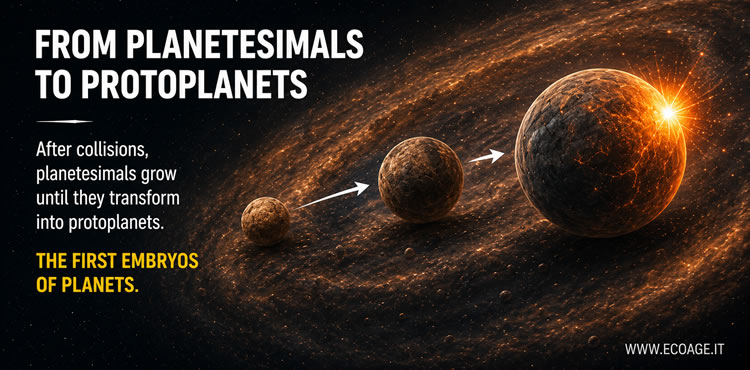
Although planetesimals were only a few kilometers across, they already possessed enough gravity to attract additional material. Through repeated collisions and accretion, they continued growing into much larger objects called protoplanets, the first true precursors of the modern planets.
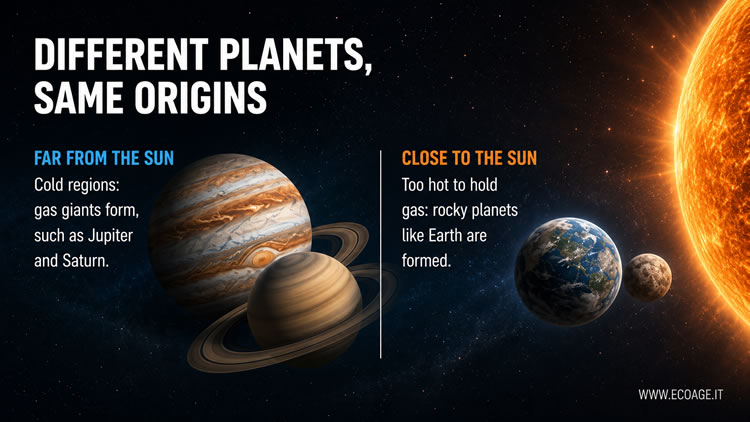
Their position within the Solar System strongly influenced their evolution. In the colder outer regions, protoplanets were able to capture enormous quantities of gas, eventually forming the gas giants such as Jupiter and Saturn. Closer to the Sun, however, temperatures were too high for large amounts of gas to remain stable. As a result, the inner planets became smaller, denser, and primarily rocky, like Earth.
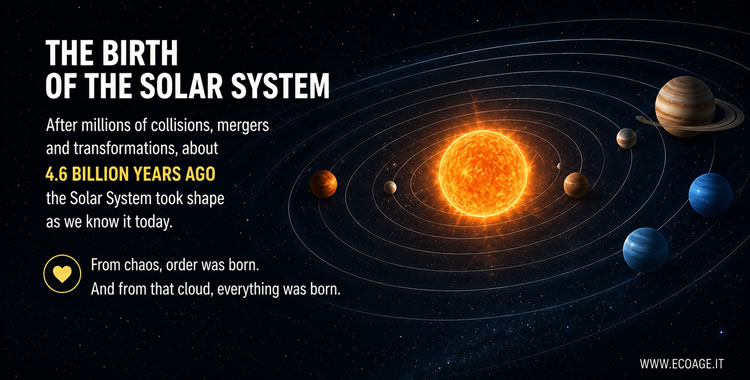
After millions of years of collisions, accretion, and gravitational interactions, the Solar System gradually evolved into the structure we observe today. From that ancient cloud of gas and dust emerged the Sun, the planets, the oceans, and eventually the conditions that made life possible.