Solar Constant
Every second, our planet is bathed in an enormous amount of energy from the Sun. But how much of that energy actually reaches Earth? Scientists answer this question using a fundamental quantity known as the solar constant.
The solar constant measures the amount of solar radiant energy received each second by a surface of one square meter positioned perpendicular to the Sun's rays at Earth's average distance from the Sun. Its mean value is approximately 1366 W/m², which means that every square meter directly facing the Sun receives about 1366 joules of energy per second.
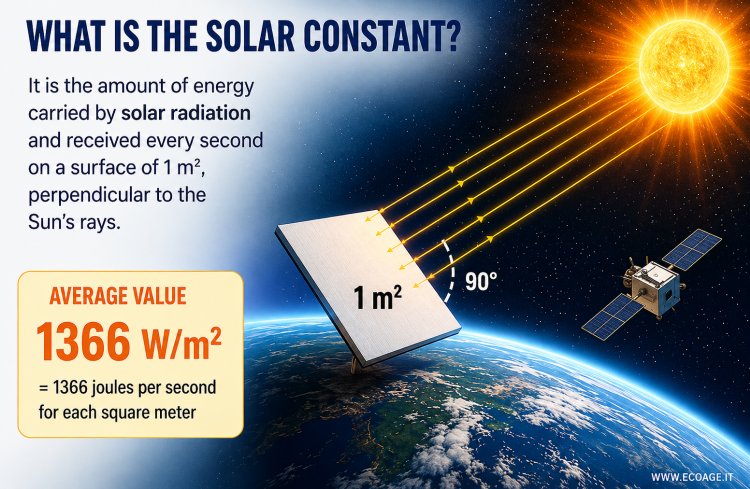
Despite its name, the solar constant is not perfectly constant. The term is used because its average value remains remarkably stable over time. Small variations do occur, however, mainly because Earth's distance from the Sun changes slightly throughout the year and because solar activity itself is not completely uniform. Phenomena such as the sunspot cycle can cause subtle fluctuations in the amount of energy emitted by the Sun.
How Scientists Measured It
Measuring the solar constant was far from straightforward. For many years, Earth's atmosphere made accurate observations difficult because it absorbs and scatters part of the incoming solar radiation.
One of the earliest attempts was made in 1885 by astronomer Samuel Pierpont Langley, who sought to estimate the Sun's energy despite atmospheric interference. Later, Charles Greeley Abbot improved these measurements through observations conducted at different elevations, obtaining values between approximately 1322 and 1465 W/m².
The real breakthrough came with the arrival of the space age. Satellites operating above Earth's atmosphere allowed scientists to measure incoming solar radiation directly, leading to far more precise results and confirming an average value close to 1367 W/m².
Why the Solar Constant Changes During the Year
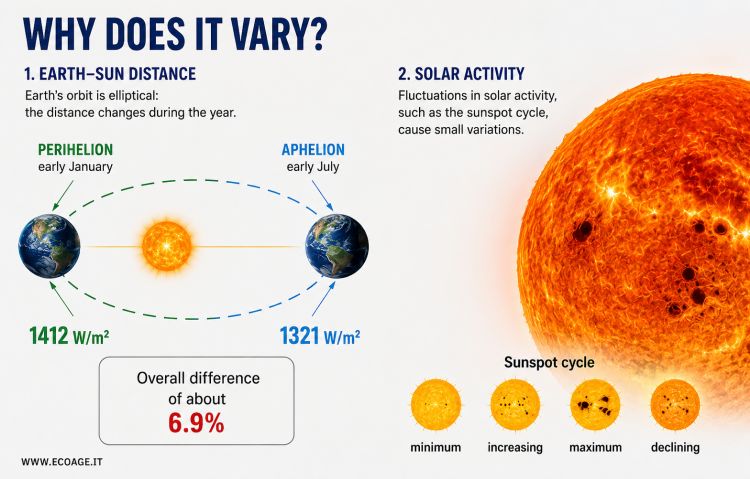
Earth's orbit around the Sun is slightly elliptical rather than perfectly circular. As a result, the distance between the two bodies changes throughout the year.
At perihelion, when Earth is closest to the Sun in early January, the incoming solar irradiance rises to approximately 1412 W/m². At aphelion, when Earth is farthest from the Sun in early July, it falls to about 1321 W/m².
The difference between these two values is roughly 6.9%. Although relatively small, it is easily measurable. Additional minor variations are caused by changes in solar activity, typically amounting to only a few tenths of a percent.
An Extraordinary Amount of Energy
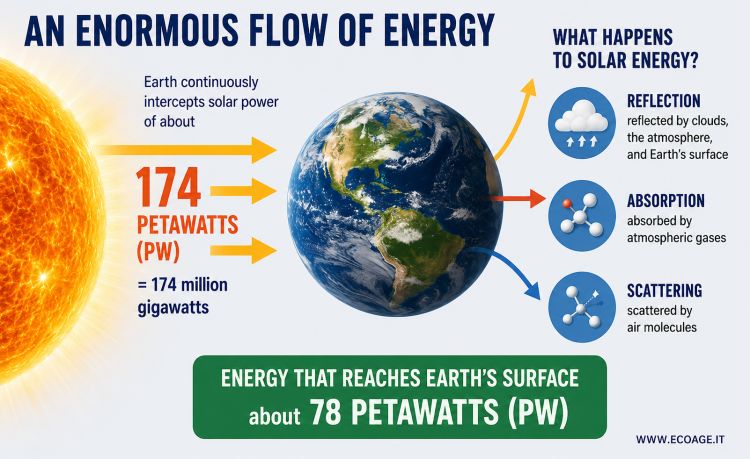
The figures become truly remarkable when we consider the entire planet rather than a single square meter. Earth continuously intercepts approximately 174 petawatts (PW) of solar power, equivalent to 174 million gigawatts.
Not all of this energy reaches the ground. As solar radiation passes through the atmosphere, part of it is absorbed by atmospheric gases, scattered by air molecules, or reflected by clouds and Earth's surface. Consequently, the amount of solar energy that ultimately reaches the surface is reduced to about 78 petawatts.
Why It Matters
The solar constant is a cornerstone of Earth's energy balance. It represents the primary source of energy that powers almost every natural process on our planet.
Solar energy drives photosynthesis, fuels atmospheric and oceanic circulation, influences global temperatures, and sustains Earth's climate system. Understanding exactly how much energy arrives from the Sun is therefore essential for studying climate change, environmental processes, and the history of life on Earth.
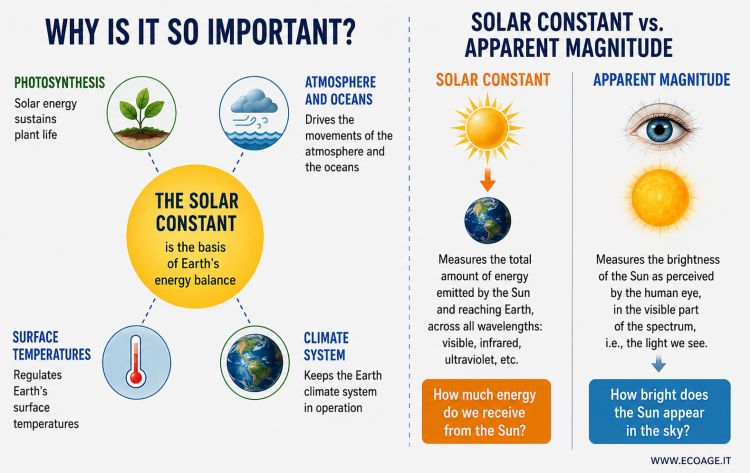
Solar Constant vs. Apparent Magnitude
The solar constant and the apparent magnitude of the Sun are often discussed in astronomy, but they describe very different concepts.
The solar constant measures the total solar energy reaching Earth across the entire electromagnetic spectrum, including visible light, infrared radiation, ultraviolet radiation, and all other wavelengths emitted by the Sun.
Apparent magnitude, on the other hand, describes how bright the Sun appears in the sky to an observer on Earth. It is primarily related to the visible portion of the spectrum detected by the human eye.
Put simply, the solar constant answers the question: How much energy reaches Earth from the Sun? The apparent magnitude answers a different one: How bright does the Sun appear in the sky?
These are two distinct measurements, but both help scientists better understand our nearest star and its influence on our planet.
How Earth's Atmosphere Modifies Solar Radiation
The Sun's energy is generated by nuclear fusion reactions that convert hydrogen into helium deep within its core. As this energy travels through space toward Earth, it spreads across an increasingly large area, causing its intensity to gradually decrease with distance.
Before reaching the Earth's surface, solar radiation must pass through the atmosphere. During this journey, approximately 55% of the incoming solar energy is absorbed, scattered, or reflected by clouds and atmospheric gases. The ozone layer in the stratosphere plays a crucial role by absorbing much of the most energetic ultraviolet radiation. At lower altitudes, water vapor and carbon dioxide absorb and scatter part of the infrared radiation.
Because of these atmospheric processes, the amount of solar energy that reaches the ground is significantly lower than the solar constant measured at the top of the atmosphere. Under clear-sky conditions, global solar irradiance on a horizontal surface can reach about 1000 W/m². In Italy, peak values generally range from 900 to 1100 W/m², depending on factors such as atmospheric transparency, geographic location, and season.
Solar radiation is measured using instruments called pyranometers, also known as solarimeters. These devices are widely used in meteorology, climatology, and solar energy engineering to monitor incoming solar irradiance and assess the performance of photovoltaic and solar thermal systems.