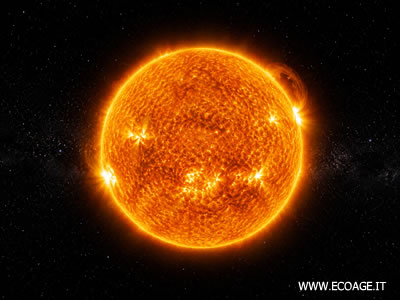
Solar Granulation
Solar Granulation: The Hidden Convective Dynamics of the Sun's Surface
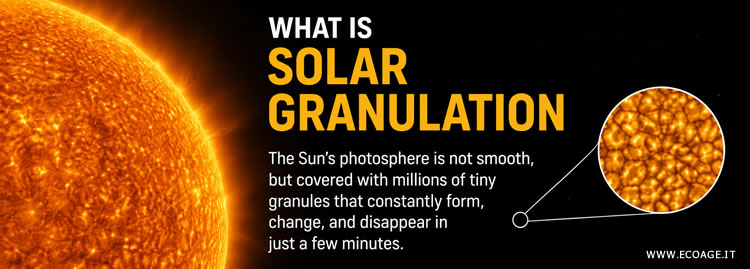
If we could zoom in on the Sun with powerful enough instruments, we would discover that its surface is anything but smooth. Instead, it appears as a constantly changing mosaic made up of millions of tiny bright cells that form, evolve, and disappear within minutes. This phenomenon, known as solar granulation, offers a fascinating glimpse into the powerful processes taking place beneath the Sun's visible surface.
The origin of solar granulation lies deep within the Sun. Energy produced by nuclear fusion in the core heats the plasma, the ionized gas that makes up nearly the entire star. As the plasma becomes hotter, it becomes less dense and begins to rise toward the surface through enormous convective currents. The process is similar to the circulation of water in a boiling pot, although it occurs on a scale far beyond anything we experience on Earth.
When these rising currents reach the photosphere, the Sun's visible surface, they create structures known as granules. These granules give the photosphere its characteristic grainy appearance, forming a complex pattern of bright regions separated by darker boundaries. At any given moment, astronomers estimate that roughly four million granules cover the solar surface.
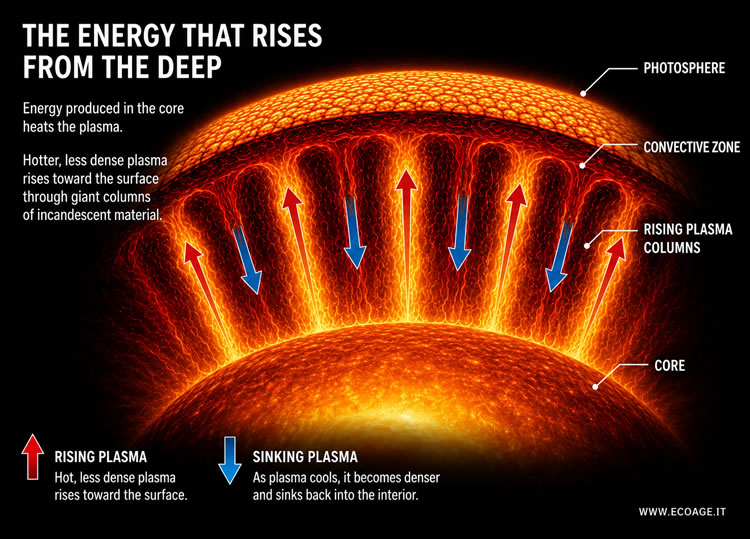
Each granule represents a single convective cell. Its bright center marks a region where hot plasma is rising from deeper layers of the Sun, making it appear more luminous than the surrounding areas. Near the edges, the plasma releases energy into space and gradually cools. As it cools, it becomes denser and sinks back into the solar interior through narrow channels known as intergranular lanes. This continuous cycle of rising and sinking plasma is what drives the granular pattern seen across the photosphere.
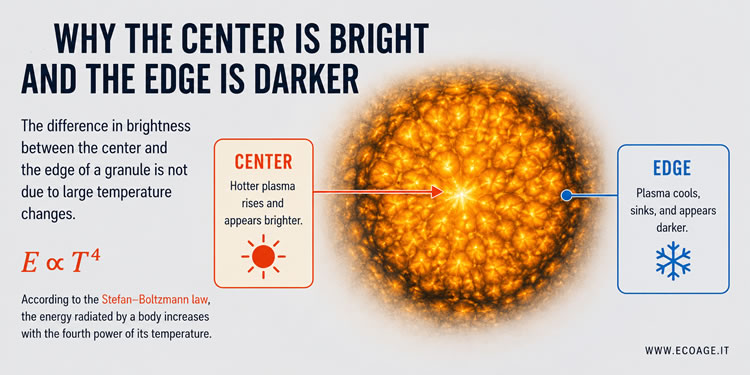
The contrast between the bright centers of granules and the darker intergranular lanes is caused by relatively small temperature differences. The reason these differences are so noticeable is explained by the Stefan-Boltzmann law, which states that the energy radiated by an object increases with the fourth power of its absolute temperature. As a result, even a modest drop in temperature can produce a significant decrease in brightness, making cooler regions stand out clearly.
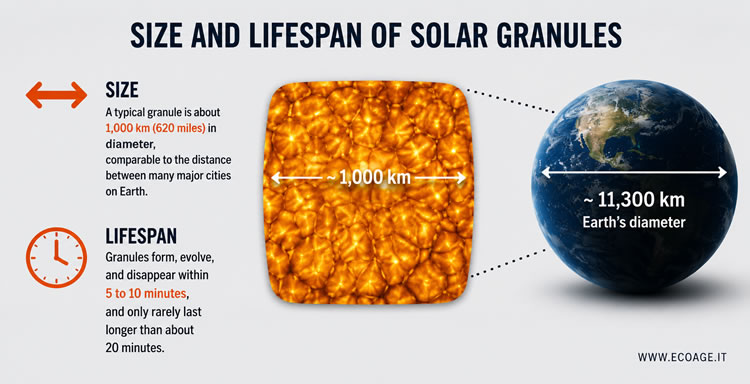
Granules are surprisingly large. A typical granule is about 1,000 kilometers (620 miles) in diameter, a distance comparable to that between many major cities on Earth. Despite their immense size, granules are short-lived structures. Most form, evolve, and disappear within 5 to 10 minutes, and only rarely survive for more than about 20 minutes.
Even larger structures exist beneath this intricate cellular pattern. Known as supergranules, these enormous convective systems can reach diameters of approximately 30,000 kilometers (18,600 miles), more than twice the diameter of Earth. Unlike ordinary granules, supergranules can remain active for up to twenty-four hours. They also play an important role in transporting plasma and influencing the distribution of magnetic fields across the solar surface.
Solar granulation reveals a side of the Sun that is invisible to the naked eye. Beneath its seemingly calm appearance lies a dynamic and turbulent environment where vast currents of plasma continuously transport energy outward. Every granule visible on the photosphere is a direct sign of this activity, offering a remarkable window into the processes that power our star and sustain its brilliance across billions of years.