Solar Wind
The Sun’s Invisible Stream of Plasma
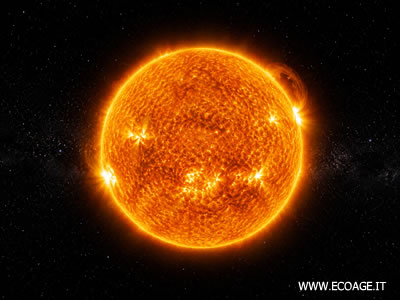
The Sun may look calm and unchanging in the sky, but it is constantly sending matter and energy into space. Every second, a continuous stream of charged particles flows outward from its outer atmosphere and spreads throughout the solar system. This phenomenon, known as the solar wind, creates an invisible link between the Sun and the planets and can even affect the technologies we rely on every day.
The solar wind originates in the solar corona, the outermost layer of the Sun’s atmosphere. From this region, an extremely thin plasma continuously expands into interplanetary space. This plasma is composed mainly of protons and electrons, which account for about 95% of its particles, while alpha particles make up most of the remainder. Once they escape the corona, these charged particles spread in all directions, creating a vast outflow that extends for more than 100 astronomical units from the Sun, reaching the outer boundaries of the heliosphere and influencing conditions across much of the solar system.
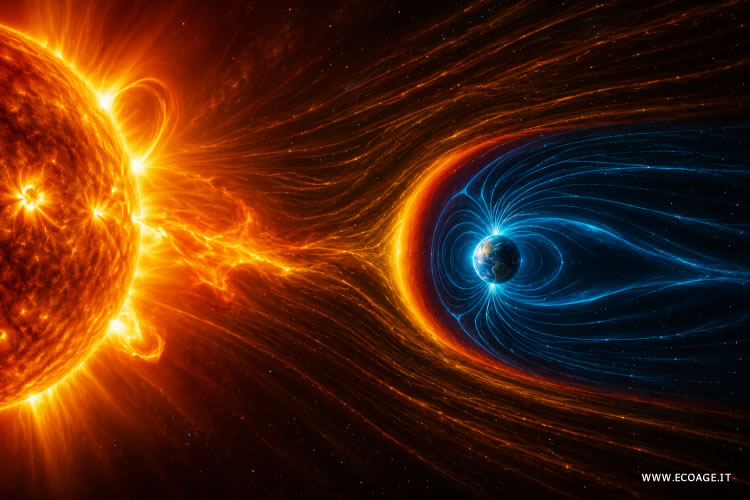
The solar wind carries more than just matter. Because plasma is an electrically conducting gas, it also transports the Sun’s magnetic field through space. This creates the interplanetary magnetic field, a vast magnetic structure that fills the space between the planets. As the Sun rotates, its magnetic field lines become twisted rather than extending outward in straight paths. The result is the famous Parker spiral, a large-scale structure that plays a key role in shaping the space environment throughout the solar system.
The solar wind is not a steady, uniform flow. Astronomers generally distinguish between two main types. Slow solar wind typically travels at speeds between 300 and 500 kilometers per second and is associated with magnetically active and complex regions of the corona. Fast solar wind, on the other hand, can exceed 700 kilometers per second and originates mainly from coronal holes, large areas where magnetic field lines open directly into interplanetary space. The interaction between these different streams helps make the space environment around Earth highly dynamic.
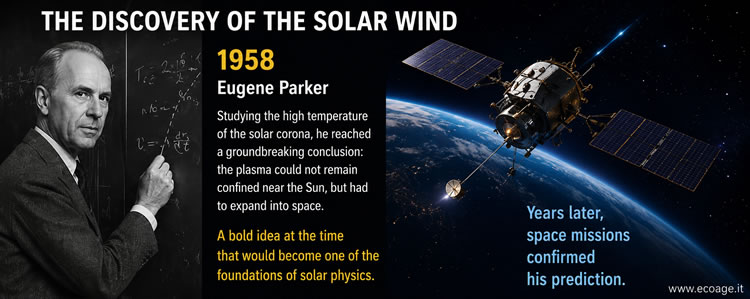
Our understanding of the solar wind is one of the great success stories of modern astrophysics. In 1958, American astrophysicist Eugene Parker studied the extremely high temperatures of the solar corona and reached a groundbreaking conclusion: the coronal plasma could not remain trapped near the Sun and had to expand continuously into space. At the time, the idea was controversial, but observations from the first space probes eventually confirmed his prediction. What began as a bold hypothesis became a cornerstone of modern solar physics and gave the solar wind its name.
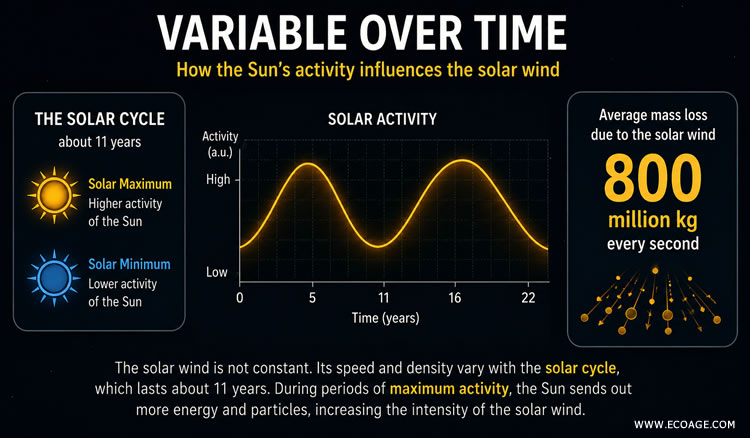
The solar wind does not always blow with the same strength. Its speed and density change over time as the Sun’s magnetic activity rises and falls. One of the main drivers of these variations is the solar cycle, an approximately eleven-year cycle that alternates between periods of low and high activity. During solar maximum, the solar wind can become particularly intense and turbulent. Although the Sun is an enormous star, this continuous outflow results in a remarkable loss of mass: about 800 million kilograms of material are expelled every second.
After traveling millions of kilometers through space, the solar wind reaches Earth. Near our planet, it typically moves at an average speed of about 400 kilometers per second, although speeds can range from roughly 200 km/s to 900 km/s. During periods of heightened solar activity, especially during solar storms, the solar wind can trigger powerful geomagnetic storms. These disturbances can affect satellites, communication systems, navigation networks, power grids, and other sensitive technologies.
 The solar wind is not only responsible for technological challenges. It also produces some of the most spectacular natural displays visible from Earth. When charged particles enter the polar regions and collide with atoms and molecules in the upper atmosphere, especially within the thermosphere, they generate the stunning aurora borealis and aurora australis. These shimmering curtains of light are the visible signature of processes that begin on the Sun itself.
The effects of the solar wind extend far beyond Earth. This continuous plasma flow shapes the magnetospheres of planets and helps determine the conditions of the space environment throughout the solar system. Comets are also affected. Their distinctive ion tails always point away from the Sun because of their interaction with the solar wind.
Far more than a simple stream of particles, the solar wind is clear evidence that the Sun is an active and dynamic star. Its influence reaches far beyond its visible surface, shaping the environments of planets, comets, and the vast space between them. By studying the solar wind, scientists gain a deeper understanding of the complex relationship between the Sun and the solar system it governs. This area of research, known as space weather, is becoming increasingly important as our world grows ever more dependent on satellites, communications, navigation systems, and other space-based technologies.