Solar Prominences
What Are Solar Prominences?
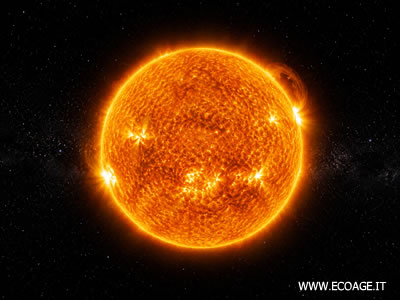
Imagine looking at the Sun and seeing enormous glowing arches rising from its surface and stretching far into space. Some of these structures span hundreds of thousands of kilometers, making them among the largest features in the entire Solar System. Although they may look like gigantic flames, they are not flames at all. They are solar prominences, immense formations of plasma suspended above the Sun by powerful magnetic fields.
How Do They Form and How Long Can They Last?
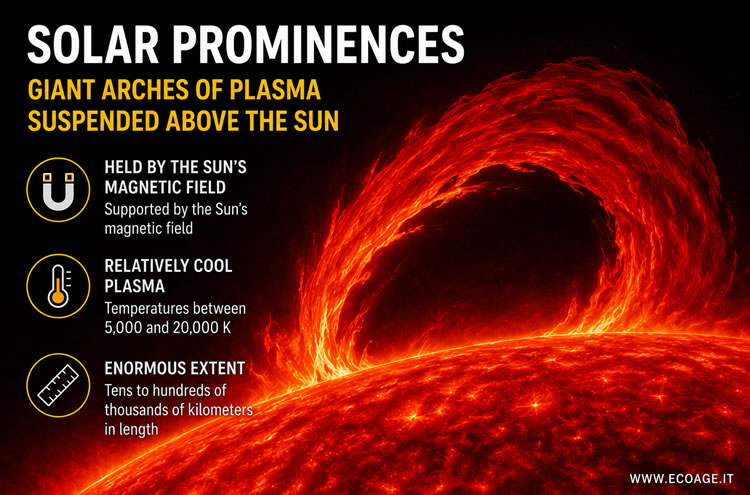
Solar prominences are made of plasma, an electrically charged gas that constitutes most of the Sun's visible matter. They form in the chromosphere and extend into the corona, the outermost region of the solar atmosphere. Rather than being freely suspended, they are held in place by complex magnetic field lines that guide and support the plasma.
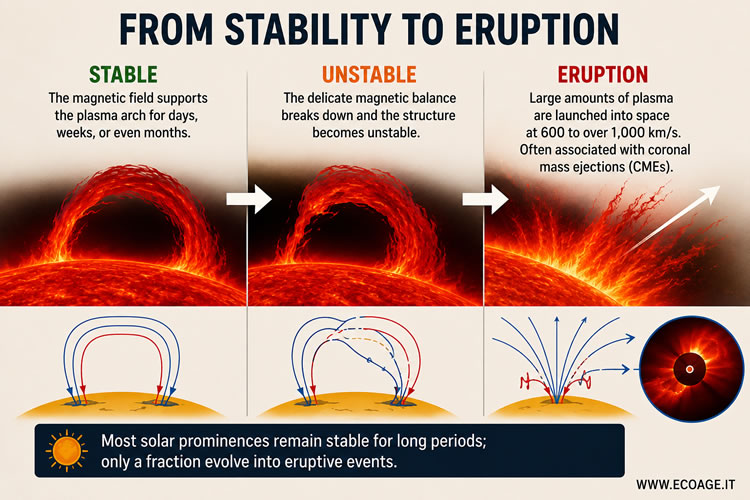
Prominences often appear as giant arches, loops, or curtains of glowing material. Some develop within hours, while others take days to fully form. Once established, they can remain stable for surprisingly long periods. Many last for weeks, and some persist for months.
When these structures are seen projected against the bright face of the Sun rather than along its edge, they appear dark and thread-like. In that case, astronomers refer to them as filaments.
How long have solar prominences been known? Observations of prominences go back centuries. The earliest known detailed description appears in the 14th-century Codex Laurentianus and refers to a total solar eclipse observed on May 1, 1185. Witnesses described strange red structures extending from the eclipsed Sun, comparing them to "tongues of living fire." It was not until the 19th century, with the development of spectroscopy and modern solar astronomy, that scientists realized these mysterious features were actually enormous clouds of plasma suspended within the Sun's atmosphere.
How Large Can They Become?
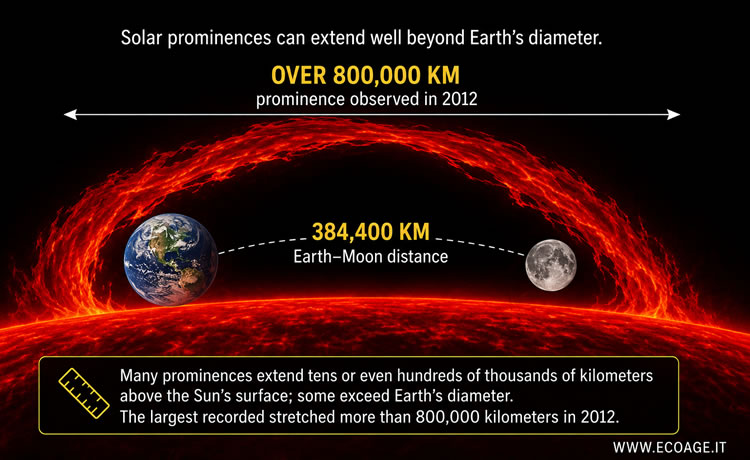
The size of a solar prominence can be astonishing. Many extend tens or even hundreds of thousands of kilometers above the solar surface, and some are far larger than Earth itself.
One of the most spectacular examples was observed in 2012. It stretched for more than 800,000 kilometers, a distance greater than twice the average separation between Earth and the Moon. Structures of this scale highlight the immense dimensions of the processes taking place on our star.
Why Are They Cooler Than the Solar Corona?
One of the most intriguing aspects of solar prominences is their temperature. The surrounding corona often exceeds one million kelvin, yet the plasma inside a prominence is much cooler, typically ranging from 5,000 to 20,000 kelvin.
This means that relatively cool, dense plasma exists within an environment that is hundreds of times hotter. Understanding how this cooler material can survive inside the extremely hot corona remains one of the major challenges in solar physics and continues to be an active area of research.
How Do Astronomers Observe Them?
Solar prominences are especially striking when viewed in Hα light, a specific wavelength emitted by hydrogen atoms. Under these conditions, they appear as delicate filamentary structures glowing in a deep red color.
Astronomers can observe prominences during total solar eclipses, when the bright solar disk is temporarily hidden by the Moon. More commonly, they use specialized solar telescopes equipped with Hα filters, which isolate this narrow wavelength range and reveal details that are normally invisible in ordinary sunlight.
Can They Evolve Into Violent Eruptions?
Not all prominences remain stable throughout their existence. In some cases, the magnetic configuration supporting the plasma becomes unstable and eventually breaks down.
When this happens, enormous quantities of plasma can be launched into space at speeds ranging from roughly 600 to more than 1,000 kilometers per second. These events, known as eruptive prominences, are often associated with coronal mass ejections (CMEs), massive eruptions that expel plasma and magnetic fields from the solar corona into the Solar System.
As these disturbances travel outward, they interact with the solar wind and can sometimes affect planets, including Earth. However, most prominences never erupt and remain stable for extended periods before gradually dissipating.
When Are They Most Common?
The number of solar prominences visible on the Sun changes over time. Like many other solar phenomena, they follow the approximately 11-year solar cycle.
During periods of solar maximum, when the Sun's magnetic field becomes more complex and active, prominences become significantly more numerous. During solar minimum, they are generally less frequent.
Major Types of Solar Prominences
Solar physicists classify prominences according to the magnetic environment in which they form. Three main categories are commonly recognized.
- Active-region prominences form within magnetically active regions characterized by strong and complex magnetic fields. They are the most common type and typically remain visible for periods ranging from a few hours to several days.
- Intermediate prominences develop in transition zones between active regions and large-scale unipolar magnetic regions. They display characteristics that are intermediate between active-region and quiescent prominences.
- Quiescent prominences form far from active regions in areas where the magnetic field is comparatively weak. They are the most stable and longest-lived prominences, often persisting for weeks or months and reaching greater heights than active-region prominences. They are most commonly observed at higher heliographic latitudes, near the Sun's polar regions.
One of the Sun's Most Fascinating Mysteries
Despite decades of observations, advanced computer simulations, and increasingly sophisticated theoretical models, scientists still do not fully understand how solar prominences form and remain suspended above the Sun.
How are such enormous masses of plasma gathered and supported against the pull of solar gravity? What determines whether a prominence remains stable or erupts into space? These questions are still being investigated.
That uncertainty is part of what makes solar prominences so captivating. They are not only among the most beautiful structures visible on the Sun, but also one of the most intriguing unsolved problems in modern solar physics.